
Grow your Business with Google Ads
“Google Ads is an online advertising platform developed by Google, where advertisers pay to display brief advertisements, service offerings, product listings, video content, and generate mobile application installs within the Google ad network to web users” (Wikipedia, 2020). There are many reasons why a marketing individual should be pursuing ads at some point in their career, whether it be for their personal benefit or for the benefit of the company they are employed for. When you first start with Google Ads, it is designed to be user friendly and give access to a broad range of accessible utilities to the user to customize as they wish, so customers are readily available for reach when ready to employ the ads. When thinking about where you should start with Google Ads, you should base your objective around your business goal; this way, Google Ads can drive sales, get leads, increase website volume, build awareness, and more with a solid idea in mind. The best way to think about growing your business is to get the full benefits designed by Google Ads; the three most important principles to remember are relevance, control, and results. These are important as they can truly capture the magic of Google Ads and make growing your awareness or business goals come to fruition. Relevance is when “Google ads helps you to connect with the right people, at the right time, with the right message. Your ads can appear on Google Search, YouTube, and more, just when someone is looking for products or services like yours” (Google, 2020). Control is when Google Ads gives you control over how much you spend on ads and how much you should or want to be spending daily or monthly. Results are paying only for results with how many websites clicks you can generate or how many phone calls your business receives. With these essential steps taken, you can begin to support your business goals with Google Ads. One of the best qualities of Google Ads is choosing your customers, and how, where, and why they see your ad campaign, you can choose to show your ad on a search engine, or display it on a webpage, inside a video, you could also try advertising on shopping websites such as Amazon, or eBay. Every business will have its own unique goal, and it will dictate how they should create the ad campaign, are they trying to increase brand awareness? Or promote their products and boost traffic? Each of these stories will be told differently when creating an ad, so how you handle the situation is dependent on your outlook and goals. “Whether you are looking to increase online sales, bring in new website visitors, get the phones ringing or keep customers coming back, Google Ads can help you to meet your goals” (Google, 2020). Optimizing your campaign and where you want targets to see your ads is essential; if you do not reach out to the correct crowd, your ad could be seen as vapid or unnecessary, so choosing your targeting is also very important when managing your campaign.
Explore the Value of Google Search
Every hour a competitor is taking your potential customer; this is why starting to learn how and what to do with Google ads is essential. The value of a search engine can be a crucial part of exploring ways to create an identity on the internet; by creating a Google Search Campaign, you allow your business to have the benefit of finding potential customers with ease. “Right now, potential customers are searching for the product or services that you offer” (Google, 2020). You can choose how your campaign is seen and who and what type of searches participants need to do to get to your product or ad, which allows a unique experience for every individual targeted. So, before you start to begin to think about where you want your ads to be seen, how much are you willing to invest in each ad, daily or monthly, what do you like to share, and finally, what keywords will match the terms your potential customer has used to find your product. Setting up a campaign is easy if you follow the recommended steps.
- Open your Google Ads account.
- Set your overarching goal for the campaign.
- Select where your text ads will be shown, and how to get exposure.
- Select what type of devices to show the ads on.
- Determine a budget, or pricing strategy.
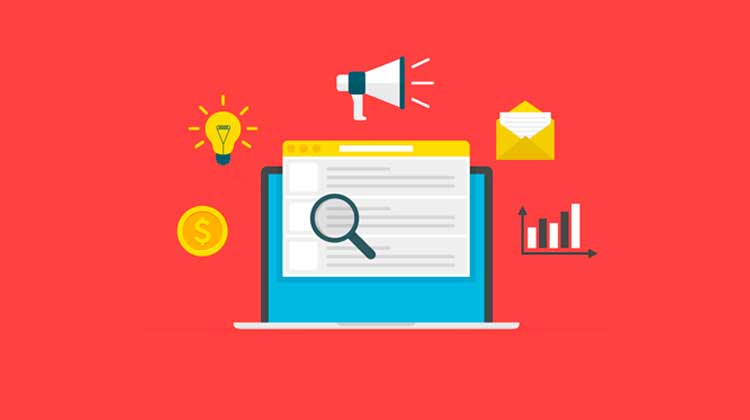
If you have followed these steps, you should create an effective ad campaign, and if you have several goals in mind, you can generate each campaign for your targeted purpose. If you have successfully created your plan, you can now create ad groups. Ad groups are phrases or terms that can be used when users search for a specific item; this can categorize different products such as shoe sizes or types. This gives more control to the seller when creating their ad campaign.
Now that you learned about creating keywords and how to target specific customers, you can dictate the algorithm Google uses to help broaden your search categories, even more, customizing keywords to match the campaign goals you have. Remember, this also allows you to create Dynamic Ads for your business, which, in return, makes your keywords more relevant and will help specify the pages and the customer type. “We make it easy for you and your ads to make that lasting connection with your customer’s thanks to different matching and keyword options” (Google, 2020).
- Think like your customer.
- Think about the business goals of your organization.
- Allow Googles algorithm to dynamically create keywords you may want.
Understand the Google Ads Auction
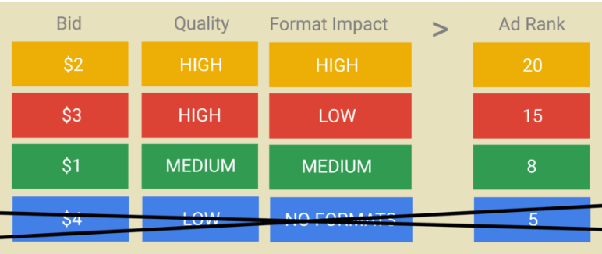
The Google ads auction is a valuable tool that allows the participant to select the ads that appear on targeted pages, and from there, you can dictate how much those ads will cost and how much earnings will appear in the account from those ads; vice versa it also allows advertisers to set a minimum price they will pay for the ads. This is all created by Google’s auction system, which categorizes and will show the ads, and in what order; this also enables Ad Rank. “Ad Ranking in Internet Marketing is the position of a pay-per-click (PPC) ad on a search engine results page” (Wordstream, 2020). Google’s algorithm will calculate scenarios for every ad; this determines the position of the ads, and if they are eligible to be shown, the better your rank, the higher and more relevant the ad will be. To determine the eligibility of the ad, you need to determine the quality. Assessing the condition is easy, as it just a matter of three simple steps. The higher the quality score, the better the ad experience and lower prices demanded.
- Expected click-through rate of the ad.
- The ad landing page experience.
- The relevance of the ad.
Deliver the Right Message with Text Ads
To be clear and get your text ad across, you will want a “simple yet powerful way to get your business in front of people” this is where sending the right message with your texted ad comes into play (Google, 2020). Creating an experience that is engaging yet informative is where you want your ad to be. To set the tone and generate an ad field description, you will want to start around 90 characters to not seeming too daunting. Other valuable tips are optimizing your ad rotation, implementing three to five ads per ad group, and using at least three extensions for each campaign your business creates. Overall with the criteria met and the right text is chosen, you will have a better response and adapt and have more relevant information about your customers and your ads.
Make Ads Relevant with Search Ad Extensions
Creating an identity on the internet is sometimes tricky. It can often lead your business goals into remote areas and create either meaningless or entirely wrong ads for your organization. Still, Ad Extensions can help you have a greater understanding of the customer and the ad. When a customer searches for a specific product or service, Google will try to understand the situation and find the customer’s need; this helps when trying to find information about a product, location, or anything else relevant to the customer. An extension comes into play to help improve the experience and increase engagement with the user; the right ad at the right time can create a significant enough difference for a potential customer to continue buying your product or service. Specific attributes of the Ad Extension can help and enhance the experience.
- Sitelinks, which direct to specific sections of the website or page.
- Callout extensions, which highlight value adding attributes about the product or service.
- Structured snippets, which is the features of a product or service, giving a idea of what you have to offer to the customer.
All these extensions help with convenience and time and have the ability to generate a positive response. The three above are not the only extensions available if you are looking for a different type of engagement; you can try other extensions to pursue, which can create a better experience for yourself and the customer. Some of these include price extension, app extension, promotion extension, and message extension, each with its unique role. Suppose you would like to create automated ads. In that case, Google will provide your options for that, which may lead to other opportunities for your business—learning how to identify which ad can be used and where is vital. It can have either a positive or a negative effect on the product and services performed. Some extensions, such as callout or site link, help provide a fluid experience when choosing the automatic route. Whether you are creating an extension to drive user engagement or trying to identify what type of ad fits in specific scenarios, Ad Extensions can help provide you the necessities you may need.
Increase Efficiency with Automated Bidding
Now that you have learned a bit about automation and how it can improve the quality of life with Ad Extensions, you can see how it works with automated bidding. Automated bidding is a plan designed by Google to maximize the results of your ad campaign. Maximizing these results is as easy as the Google Ads automated bidding process. It is crucial to create a bidding process that will work with your organization’s goals so you can create a more impressive amount of interaction you get. There are multiple strategies to choose from when dealing with automated bidding. Awareness-based approaches are used to create certain queries for specific purposes. Consideration strategies are for creating as many clicks as possible. Conversion strategies are chosen if you are trying to track post-click actions. Revenue strategies are there to help you track the revenue or value to maximize profits. Each has its unique purpose, so the one used should be based on the strategy you have identified and would like to explore further.

Reach Valued Customers with Search Audiences
Finding the potential customer when you want them to purchase your product is not impossible; it is easier than it sounds, and Audience Solutions can help with this practice. “Audience Solutions allow you to create audience lists to layer on your ad groups, combining intent and insights to send the right message to the right customer with the right bid. This is important because today’s customers expect frictionless experiences across all channels, providing them with the relevant information they seek” (Google, 2020). This allows you to reach the targeted group of customers who will buy your product once they see it. The layers created help to excavate more in-depth, giving you a more individualized experience and outlook on potential customers, which gives the customers exactly what they want. Google Solutions also allows you another valuable tool, creating audience lists; all of these can help you find the perfect candidate for your product. Affinity Audiences, Detailed Demographics, and In-Market Audiences are there to be used at your leisure.
- Affinity Audiences are used in certain circumstances when you the audience has a specific interest in a topic.
- Detailed Demographics give insight about the activities of the customers personal life.
- In-Market Audiences help the marketer tell the difference when the customer has interest or intent in the product or service.
All three of these solutions are valuable resources; in my opinion, I would say In-Market Audiences is the most important as it allows you to find potential customers who are there to buy your product, which will create a higher ROI for the business. You want a customer who has the mindset to purchase the product, not to browse and leave soon after. You need to connect with people who are ready to buy. The best way to find a customer who is prepared to buy is with data, and you need to collect information that will benefit your organization continually and the ad campaign you set. Regardless of trying to find new potential targets or customers who seem to buy your product month after month, Google Solutions can prove itself to be a substantial part of your organization.

Boost Performance with Optimisation Score
Optimizing Google Ads is fueled by a concept that is called optimization score. Optimization score is a feature that will estimate the likely hood of your campaign and how well it will do; the higher the score, the better performance of it. You can see a percentage from 0-100, which will allow you to estimate the performance of your current ad; the higher the score, the closer it is to run at full potential. The main reason for the rating is to find weaknesses and improve your ad to identify areas of improvement so the score can increase. Within the interface, on the ads page, you will see many recommendations and suggestions to give your ad a better chance to succeed.
Increase Conversions with Performance Planner
The final topic in the Google Ads Skill shop is centered around Performance Planning and why it is crucial to think about when trying to get the most out of your current ad. “Planning is the crucial first step to achieving success with Google Ads” (Google, 2020). The Performance Planner is a tool used from Google’s learning algorithm to reveal all the ad’s outcomes and prospects. The device will massively increase the ROI if used correctly, as you can monitor weekly to monthly campaigns with it, forecasting certain elements to improve quality of life. The tool will generate a forecast for your ad every day and set a budget that works with your campaign for optimal results and growth; this will also teach you the budget planning process. Using such techniques will result in finding better ways to manage your ads performance so you can optimize weekly or monthly to drive more sales with a better ad. If used correctly and have managed to set specific goals and implemented plans Within the Google Ads Performance Planner, you will start to find new opportunities within your organization as your brand awareness advances into the next stages.
Conclusion
Throughout this semester, I have learned a different amount of information relating to topics that I never thought I would have an interest in, from LinkedIn Learning to Social Media ROI, I have found myself intrigued by the idea and concepts of Social Media Marketing and how it can improve my goals as a marketer. When I first took this class, I had no real idea about what it could be. Would I be surfing the web all day? Or just writing blogs, but it was so much more than that. With Google Ads as my last content for this class, I wanted to say a quick thank you to Ray Bilodeau for a great semester and applaud him for his excellent teaching philosophy. I managed to work on this Blog over the week. While I thought to myself what I could use as a conclusion related to my actual personal life, I found myself thinking about the new experiences marketers must be going through during the COVID-19 situation. It must be difficult for many right now, but marketers must change how they have created content in the past, and it may be a problematic new experience they find themselves in.
- Marketers must be more empathetic and sensitive during a crisis.
- Timelines and scheduled content must be stopped at a rough time in case of inappropriate areas of the ad or campaign.
- The imagery and language of an ad might need to be changed, especially in the case of representation, as that can be more impactful and powerful.
- Try not to capitalize on the crisis, as it may backfire.
- Remain positive.
- Think about areas where you can help with your brand.
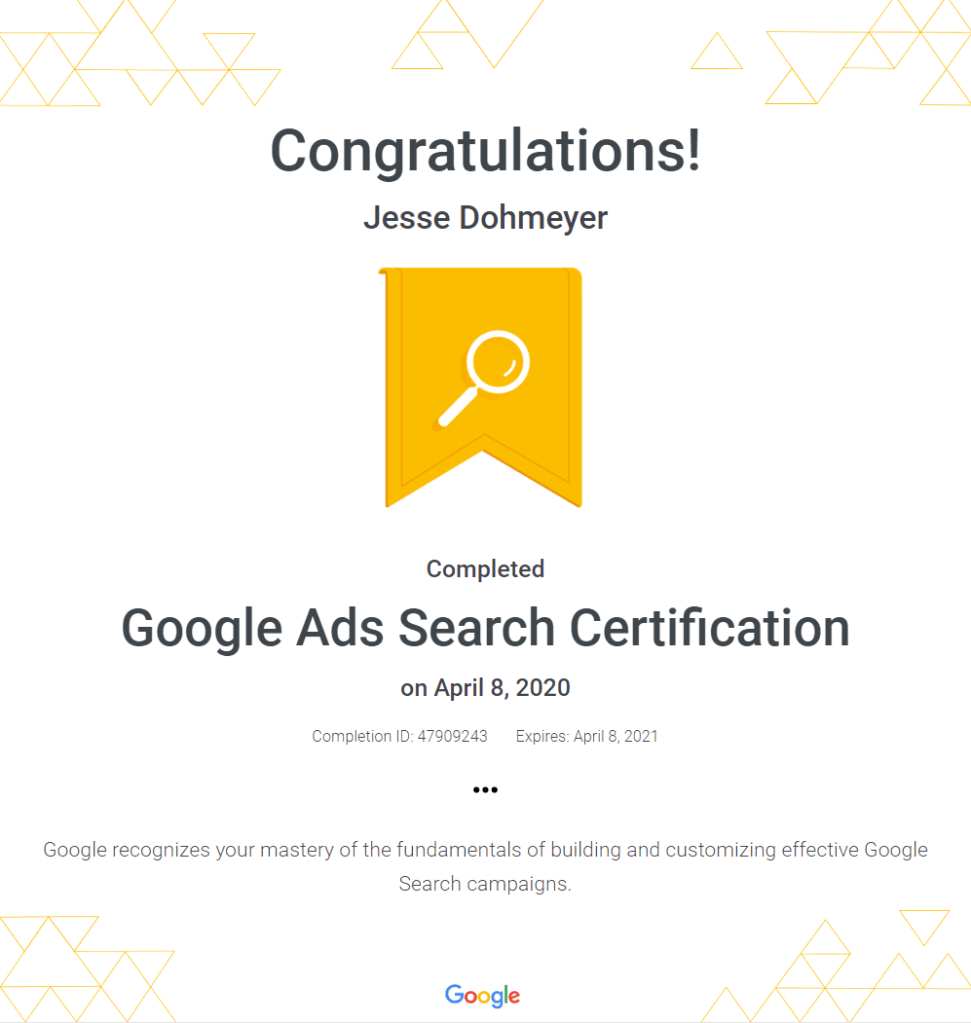
Businesses may struggle right now, but remember that the COVID-19 outbreak will not last forever; some of the numbered areas above are some elements I believe marketers will work with as the situation gets more and more dangerous. This relates to Google Ads is an excellent way as marketers must change their tactics, and the way they used Google Ads before might be brand new now with these continuous developments. To end my conclusion on a brighter note, instead of all this negative talk, I would like to say one more thing before my conclusion is over, I took the Google Ads Search Certification test and passed, and would like to congratulate myself as the study was a grind, here is the proof below.
References
Wikipedia Contributors. (2020, April 12). Google Ads. Wikipedia; Wikimedia Foundation. https://en.wikipedia.org/wiki/Google_Ads
Ad Ranking: What Is Ad Ranking? (2020). Wordstream.Com. https://www.wordstream.com/ad-ranking
All Topics : Google. (2020). Exceedlms.Com. https://skillshop.exceedlms.com/student/catalog/browse?utm_source=website_17th_sep&utm_medium=uni_header&utm_campaign=get_started
 JDigitalized